
Thread selection plays an important role in the installation, sealing, and maintenance of a mini ball valve. Female, male, and male-female threaded connections each serve different pipeline layouts. In this article, we explain how to choose the right thread configuration, match pipe dimensions, and avoid common installation problems. Drawing on our valve manufacturing experience, Joepai examines the practical considerations behind selecting a Stainless Steel Mini Ball Valve for water treatment, gas control, industrial instruments, and compact fluid systems.
Table of Contents
When selecting a mini ball valve, we recommend checking the connection structure before comparing appearance or price. The thread configuration determines how the valve connects to the pipeline, whether additional fittings are needed, and how much installation space is available.
At Joepai, our Stainless Steel Mini Ball Valve supports three main connection configurations: female-to-female threads, male-to-male threads, and male-to-female threads. Each configuration is intended for a different installation arrangement.
| Thread Configuration | Connection Structure | Typical Installation | Main Consideration |
|---|---|---|---|
| Female x Female (F x F) | Internal threads at both ends | Connecting two male-threaded pipe fittings | Requires compatible male threaded connectors |
| Male x Male (M x M) | External threads at both ends | Connecting two female-threaded ports | Check port spacing and thread engagement |
| Male x Female (M x F) | One external thread and one internal thread | Connecting different port configurations in one line | Useful for compact or mixed-connection layouts |
For example, a female-to-female valve is a practical choice when both pipeline fittings have external threads. A male-to-female design can simplify a connection between a female equipment port and a male-threaded pipe fitting. The correct choice depends on the actual connection points rather than the valve size alone.
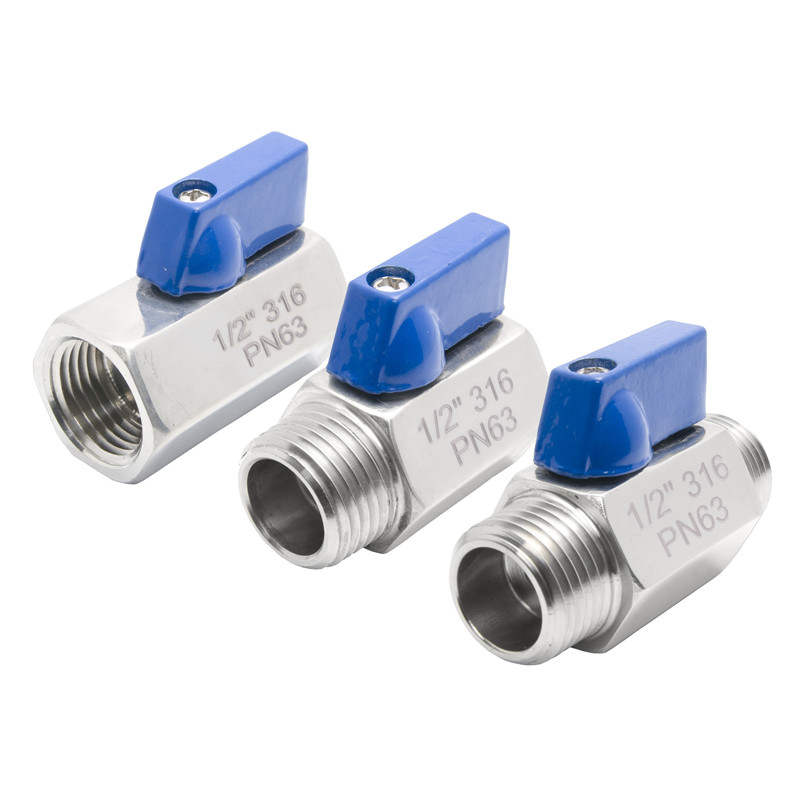
A female-threaded mini ball valve has internal threads at both ends. It is commonly installed between two male-threaded connectors, making it suitable for small water purification systems, filter assemblies, and industrial instrument pipelines.
One advantage is its straightforward integration with existing male-threaded fittings. However, installers need to check the available space around the valve and ensure that both connectors have compatible thread specifications. Excessive tightening can damage threads or place unnecessary stress on the valve body.
A male-threaded mini ball valve has external threads that screw directly into female-threaded ports. This arrangement can reduce the number of intermediate fittings in equipment with pre-machined threaded connections.
For compact equipment such as water dispensers, small filtration units, and pneumatic control modules, reducing unnecessary adapters can make the overall assembly more organized. During installation, we recommend checking the thread engagement depth and sealing method to prevent leakage.
A male-female mini ball valve combines one external threaded end with one internal threaded end. It is particularly useful when the two connection points in a pipeline have different thread structures.
For example, one side may connect directly to a female port on a machine, while the other side connects to a male-threaded pipe fitting. This configuration can reduce the need for an additional adapter and help save installation space.
When designing a compact fluid control assembly, we suggest considering the connection direction, handle operating clearance, and future maintenance access together. A valve that fits the thread specifications but leaves no room to turn the handle is not a good installation choice.
Thread size is another important factor when selecting a Stainless Steel Mini Ball Valve. A valve may have the correct connection type but still be unsuitable if its nominal thread size does not match the pipeline or equipment port.
Joepai provides several standard size options, from G1/8" to G1". The corresponding nominal sizes range from DN6 to DN25, covering many small-bore fluid control applications.
| Nominal Size | Thread Size | Dimension D (mm) | Length L (mm) | Handle Width W (mm) | Height H (mm) |
|---|---|---|---|---|---|
| DN6 | G1/8" | 7 | 40 | 22.8 | 26.5 |
| DN8 | G1/4" | 7 | 40 | 22.8 | 26.5 |
| DN10 | G3/8" | 7 | 40 | 22.8 | 26.5 |
| DN15 | G1/2" | 9.2 | 46 | 22.8 | 28.3 |
| DN20 | G3/4" | 12.5 | 54 | 22.8 | 31.5 |
| DN25 | G1" | 15 | 65 | 22.8 | 34 |
Note: Dimensions are based on the standard product specifications provided by Joepai. Confirm the detailed drawing and thread standard before ordering, especially for customized connections.
We usually recommend checking the following details before confirming a valve model:
One point worth emphasizing is that G1/2" and NPT 1/2" are not automatically interchangeable. Their thread geometry and sealing arrangements differ. Matching the nominal diameter alone does not guarantee a secure connection.
Thread compatibility determines whether a valve can be installed correctly, but material selection affects its suitability for the working environment. For small fluid systems, we recommend evaluating the valve body, ball, sealing components, and conveyed medium together.
Joepai manufactures its Stainless Steel Mini Ball Valve using forged stainless steel 304 or 316 for the main stainless steel structural components. Compared with brass mini ball valves, stainless steel options can provide better resistance to rust and many corrosive environments, depending on the actual medium and operating conditions.
| Component | Material | Function |
|---|---|---|
| Valve Body | Stainless Steel 304 / 316 | Provides the main pressure-containing structure and corrosion resistance |
| Ball | Stainless Steel 304 / 316 | Controls flow through a quarter-turn operation |
| Seat / Sealing | PTFE | Provides the sealing interface around the ball |
| O-ring | NBR | Supports sealing around the relevant connection or stem area |
| Bonnet | Stainless Steel 304 / 316 | Forms part of the valve assembly structure |
| Handle | Color-coated Aluminum | Provides manual opening and closing control |
PTFE seats are commonly used in ball valves because of their chemical resistance and low-friction characteristics. However, the suitability of PTFE and NBR depends on the fluid, temperature, pressure, and cleaning conditions. A material combination should always be checked against the actual service requirements.
For applications involving water purification, light oil, industrial instruments, or mildly corrosive liquids, a 304 Stainless Steel Mini Ball Valve may be suitable. Where the medium or operating environment requires greater corrosion resistance, a 316 Stainless Steel Mini Ball Valve is worth evaluating.
In our experience, many small valve installation problems are related to thread mismatch or improper assembly rather than the valve's compact structure. The following checks can help reduce avoidable installation issues.
BSP and NPT threads have different thread profiles and sealing characteristics. Even if their nominal sizes appear similar, forcing them together can cause poor engagement, damaged threads, and leakage. Always verify the thread standard on both the valve and the mating fitting.
Over-tightening can damage threaded connections or transfer excessive mechanical stress to the valve body. Use suitable tools and follow the installation requirements for the specific thread and sealing method.
Different thread systems use different sealing arrangements. Parallel threads such as BSPP generally require an appropriate sealing element at the connection, while tapered threads rely on their designed thread engagement and compatible sealing practices. Do not assume that one sealing method works for every connection.
A mini ball valve is often selected because of its compact dimensions. However, the handle still needs enough room to rotate. Before fixing the valve position, check whether nearby pipes, panels, or equipment housings will interfere with operation.
Thread compatibility alone does not confirm that a valve is suitable for a particular service. Check the body material, seat material, O-ring compatibility, operating pressure, and temperature limits. For steam, gas, or chemical service, obtain the manufacturer's confirmed operating ratings before installation.
Different thread arrangements can make a practical difference in compact equipment. Based on the application fields of our mini ball valve range, the following examples illustrate how connection selection affects installation.
| Application | Typical Connection Consideration | Selection Priority |
|---|---|---|
| RO Water Purification Equipment | Compatibility with filter housings and threaded pipe fittings | Compact size and reliable shut-off |
| Industrial Instrumentation | Connection to small-bore instrument ports | Thread accuracy and installation clearance |
| Gas Supply Branch Lines | Matching the specified pipeline thread and sealing system | Material compatibility and approved service ratings |
| Pneumatic Control Modules | Integration with existing threaded connectors | Compact layout and easy manual operation |
| OEM Modular Equipment | Matching equipment ports and assembly dimensions | Consistent specifications and customization options |
For OEM equipment manufacturers, connection configuration should ideally be confirmed during the initial design stage. Selecting the correct male or female thread arrangement can reduce adapter requirements, simplify assembly, and make later replacement easier.
At Joepai, our predecessor, Jingyue Valve Factory, was established in 2003 and focused on stainless steel ball valves, fire hydrants, and booster valves. Wenzhou Joepai Valve Co., Ltd. was established in 2020 to expand the business into a broader range of industrial valves, including gate valves, globe valves, check valves, butterfly valves, strainers, and fully welded ball valves.
For our mini ball valve products, we support different connection configurations, stainless steel material options, and customized thread requirements for OEM projects. Customers can provide drawings, connection details, or equipment specifications so that the required configuration can be evaluated before production.
Before placing an order, we recommend preparing a few basic details rather than selecting a valve based only on its nominal size. This helps avoid unnecessary adapters and installation changes after delivery.
Choosing a valve with the correct thread configuration from the beginning can simplify installation and reduce the number of connection points. For compact water treatment systems, industrial instruments, and OEM fluid control equipment, this small selection detail can make the entire assembly more practical.
To learn more about Joepai's stainless steel valve solutions, or to discuss a customized Stainless Steel Mini Ball Valve, contact our team with your required size, thread standard, material, and application details.
Female threads are located inside the valve connection and accept male-threaded fittings. Male threads are located on the outside of the connection and fit into female-threaded ports. The choice depends on the existing pipeline or equipment interface.
Joepai supports female-to-female, male-to-male, and male-to-female connection configurations. Customized thread arrangements can also be discussed for OEM orders, subject to technical evaluation.
The standard size range provided for this product is DN6 to DN25, corresponding to G1/8", G1/4", G3/8", G1/2", G3/4", and G1". Customized thread sizes can be evaluated according to project requirements.
They should not be treated as directly interchangeable. BSP and NPT have different thread profiles and sealing characteristics. Use the correct matching thread or a properly specified adapter designed for the application.
304 stainless steel is suitable for many general water and industrial applications. 316 stainless steel offers improved resistance to certain corrosive environments, particularly those involving chlorides. The final choice should be based on the fluid composition, temperature, and operating conditions.
It may be suitable for certain gas control applications, but the valve must have confirmed pressure ratings, sealing compatibility, and approval for the specific gas service. Always verify the manufacturer's technical documentation and applicable local requirements before installation.
Yes. Joepai can evaluate OEM requirements involving special thread sizes, connection configurations, materials, dimensions, and other product details. Providing a technical drawing or the specifications of the mating pipeline connections helps us assess the project more accurately.